
WATER PROBLEMS · WESTERN PA & NORTHEAST OHIO
The water isn’t blue. Your pipes are, and low-pH water is dissolving them a little at a time. The stain is the warning; the pinhole leak is the bill. A test reads the pH; a neutralizer, sized to it, ends the corrosion.
Serving our communities since 1967
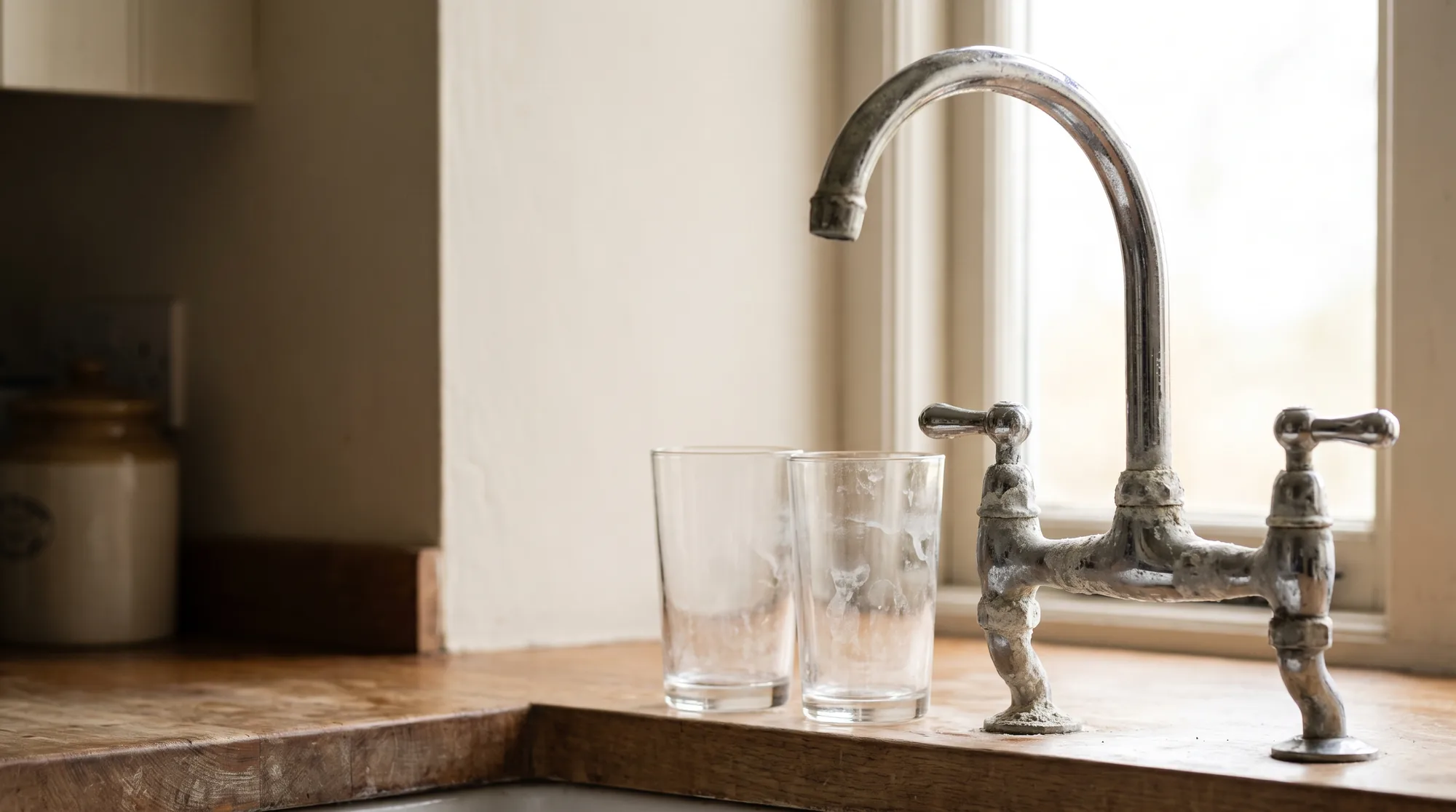
- Blue-green stains under a dripping faucet, around the drain, in the tub
- Pinhole leaks in copper pipe, or a green crust at the joints
- A metallic or sour taste; a water heater or fixtures wearing out early
- A blue-green tint left in a white basin after water has stood in it
- A softener or filter whose media never seems to last
Symptoms overlap, and more than one can be true at once. A water test settles it.
Schedule a water testWHAT IT IS
The Water Isn’t Blue.
Your Pipes Are.
Rain is naturally a little acidic. Where the ground it passes through has limestone to neutralize it, the well comes up in the EPA range; where the ground is sandstone, shale, or glacial sand, the water stays below pH 6.5 and arrives corrosive. Low pH does not stain anything by itself. It dissolves a little copper from every foot of pipe and every brass fitting on the way to the tap, and the copper is what stains: blue-green wherever the water drips and dries.
With the copper comes lead, from older solder, brass, and fittings, which is why the lead line on a test matters more on an acidic well than on any other. In the USGS record for the 10 counties we serve, 6% of 472 sampled wells were below 6.5; the pattern is strongest in Venango County, PA, and shows in 3 of the 10 counties. Hard water and acidic water are opposite problems, and the same road can have both.
How to confirm it
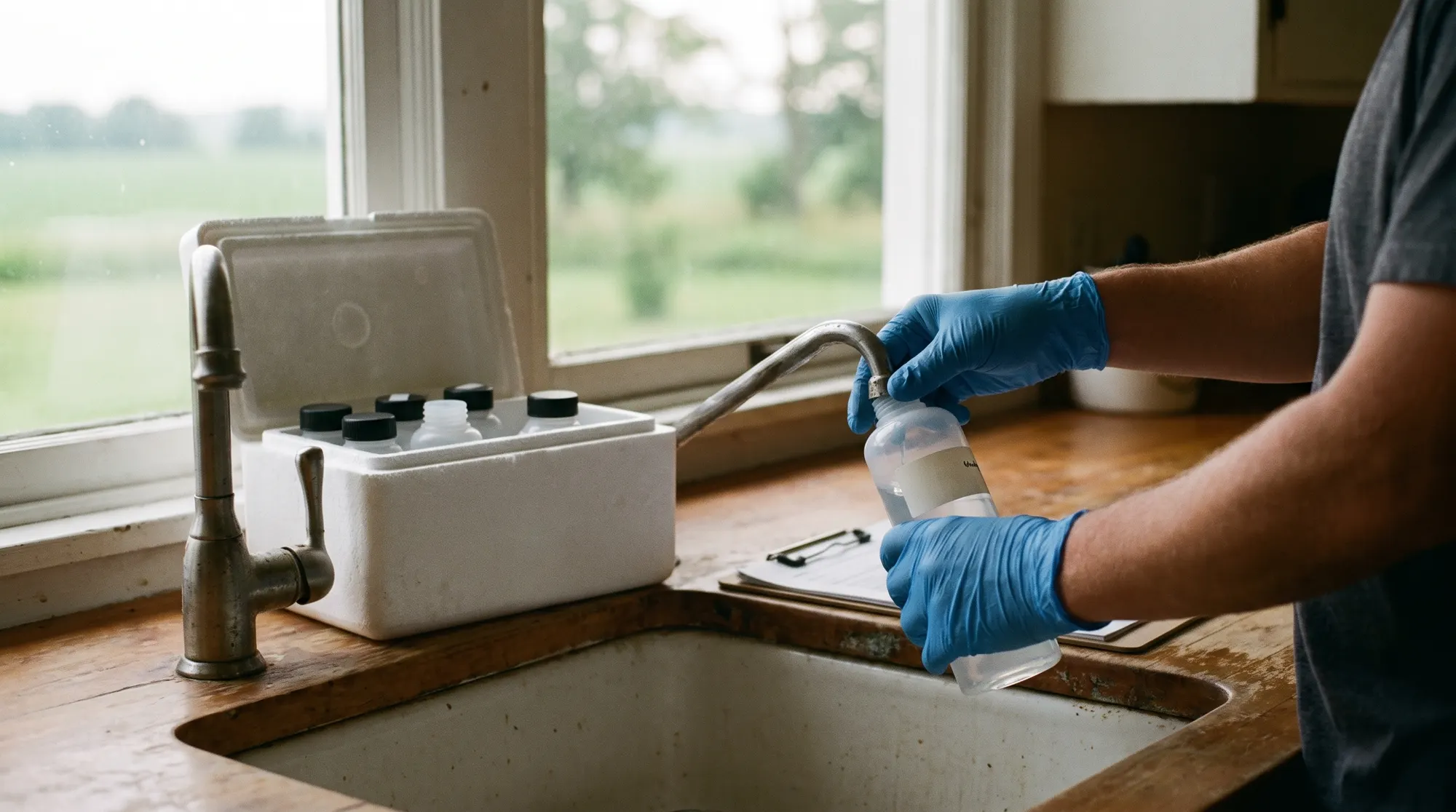
pH is measured on site, because it drifts in a shipped sample. The same visit reads alkalinity, which is the water’s buffering capacity and the number that sizes the neutralizer, and, when the pH is low, a first-draw copper and lead sample from a tap that has stood overnight. Hardness, iron, and bacteria come on the same panel.
EPA secondary standard: 6.5 to 8.5. The scale is logarithmic, so water at 5.5 is ten times as acidic as water at 6.5; a tenth of a point matters, and the neutralizer is sized to it.
- WHAT NEUTRALIZING CHANGES
- The blue-green stains stop; copper stays in the pipe
- Lead and copper stop leaching into the drinking water
- New pinhole leaks stop starting (existing ones still need a plumber)
pH BY COUNTY
What the Public Record Says,
County by County.
USGS groundwater records for all ten counties, with the most acidic wells first. The table shows what is common in your area, but acidity varies from well to well, so yours needs its own test.
| County | Median pH | EPA range | Below 6.5 | Record |
|---|---|---|---|---|
| Venango County, PA | 6.3 | Acidic | 60% of wells | 5 wells, 1928–2023 |
| Butler County, PA | 7.1 | In range | 13% of wells | 15 wells, 1926–1997 |
| Trumbull County, OH | 7.3 | In range | 12% of wells | 24 wells, 1997–2013 |
| Mercer County, PA | 7.4 | In range | 9% of wells | 96 wells, 1928–2023 |
| Ashtabula County, OH | 7.8 | In range | 8% of wells | 48 wells, 1982–2016 |
| Erie County, PA | 7.6 | In range | 4% of wells | 208 wells, 1927–2023 |
| Crawford County, PA | 7.8 | In range | 4% of wells | 28 wells, 1928–2023 |
| Columbiana County, OH | 7.1 | In range | 0% of wells | 14 wells, 1986–2016 |
| Lawrence County, PA | 7.4 | In range | 0% of wells | 27 wells, 1928–2023 |
| Mahoning County, OH | 7.6 | In range | 0% of wells | 7 wells, 1978–2001 |
Source: USGS National Water Information System groundwater records, served through the Water Quality Portal, site type Well, retrieved 2026-09-14. Each well counts once, as the median of its samples; rows with fewer than ten wells are thin and read as a hint. The 6.5 to 8.5 range is the EPA secondary standard, an aesthetic limit; the copper and lead the acid carries are regulated separately, by action level.
WHAT IT COSTS YOU
A Slow Leak,
Everywhere at Once.
Corrosion is the one water problem that damages the house rather than the fixtures. It works on every copper pipe in the walls at the same rate, silently, until the thinnest spot lets go.
- Pinhole leaks. The first one shows up as a damp ceiling or a green crust at a joint. The last one is a repipe.
- The water heater and fixtures. Tanks, valves, and cartridges corrode from the inside and fail years early; the stains on the porcelain do not scrub off, because the metal is in the surface.
- Copper and lead in the water. The metal the acid dissolves is in the glass, and both copper and lead have EPA action levels. Lead matters most for children, and a first-draw test is the only way to know.
- Treatment equipment. Softener resin and filter media are attacked by acid water too, which is why a neutralizer goes first in the sequence and the softener follows it.
THE FIX
The Neutralizer
Page.
Sized from the test, a neutralizer raises the pH before the water meets a pipe.
THE FIX
Raise the pH
Before the First Fitting.
A neutralizer at the point of entry passes the water through calcite, which dissolves a little calcium carbonate into it and lifts the pH into the EPA range before the water reaches any copper. It is sized from the pH and the alkalinity on the test, and it adds a little hardness, which the sequence accounts for.
- CALCITE NEUTRALIZER
Sized from the test, first in line.
Calcite, blended with magnesium oxide for very low pH, sits in a tank that backwashes like a filter and gets its media topped up at the annual service. Copper stays in the pipe, the stains stop, and the lead line on the next test comes down with the pH.
Every system we install - AFTER THE NEUTRALIZER
Hardness goes up a little. A softener follows.
Calcite adds calcium, so a well that was already hard gets a softener next, downstream of the neutralizer. A softener cannot protect the plumbing from acid, so the order is never reversed.
How a softener works
A LITTLE CLARITY
Acidic Water Questions.
Straight Answers.
What causes blue-green stains in my sink and tub?
Copper, dissolved out of your own plumbing by acidic water. Water below about pH 6.5 is corrosive; every foot of copper pipe and every brass fitting gives up a little metal to it, and where the water drips and dries, the copper is left behind as a blue-green stain. The stain is the visible sign; the pipe wall thinning is the expensive one.
Is acidic well water safe to drink?
The acidity itself is not the concern; plenty of foods are more acidic than any well. The concern is what it dissolves on the way to the tap: copper, and lead from older solder, brass, and fittings. Both have EPA action levels (1.3 mg/L for copper, 15 µg/L for lead), and the only way to know where your water stands is a first-draw sample from a tap that has sat overnight. A pH result below 6.5 is the reason to order that sample.
What pH should well water be?
The EPA secondary standard is 6.5 to 8.5. Below 6.5 the water is corrosive; above 8.5 it tastes flat or soda-like and tends to scale. Most wells in our counties sit inside the range, but the exceptions are real, and the scale is logarithmic, so water at 5.5 is ten times as acidic as water at 6.5.
How is low pH fixed?
With a neutralizer at the point of entry: a tank of calcite (calcium carbonate), sometimes blended with magnesium oxide for very low pH, that dissolves a little into the water as it passes and raises the pH into the EPA range. It is sized from the pH and the alkalinity on the test, and it needs its media topped up every year or two, which is part of a service visit.
Will a neutralizer make my water hard?
A little, yes. Calcite is calcium carbonate, and what it adds to the water is hardness, usually a few grains per gallon. On a well that was soft to begin with it rarely matters; on one already in the hard range, a softener follows the neutralizer in the sequence, never the other way around, because a softener cannot protect the pipes from the acid.
Why is my well acidic when my neighbor’s isn’t?
Rain is naturally slightly acidic, and groundwater stays that way unless the rock it passes through neutralizes it. Limestone and dolomite buffer it; sandstone, shale, and glacial sand do not. Two wells on the same road can draw from different depths and different layers, so one comes up corrosive and the other does not. The county record below shows what is typical nearby; only a test speaks for your well.
Talk with the Chatfield team.
(724) 588-2652A LITTLE KNOWLEDGE GOES A LONG WAY
Know Your Water.
 WATER PROBLEMS
Do you have hard water?
The opposite problem, and the softener that follows a neutralizer when the water needs both.
 WATER TESTING
Water testing, explained.
What a test measures, what the results mean, and what happens next.
 WATER PROBLEMS
Lead, and the other contaminants a test finds.
The health-based results, including the lead that acidic water pulls from old plumbing.
YOUR NEXT STEP
Know Your pH.
Then Protect the Pipes.
A water test reads the pH, the alkalinity, and the copper and lead the water is already carrying. From there, the neutralizer is sized to your well’s own numbers.