

WATER PROBLEMS · WESTERN PA & NORTHEAST OHIO
Forever chemicals, solvents, nitrate, arsenic, and lead can’t be seen, smelled, or tasted. Two of them are missing from the test most well owners have had, and a softener touches none of them. Here is what each is, where it comes from here, and the treatment built from the result.
Serving our communities since 1967
- Nothing. These have no taste, color, or smell; a lab report is the only sign
- A home near an airport, military base, fire-training ground, landfill, or industrial site
- A shallow well in farmed country, or a septic system uphill of it
- Older plumbing with lead solder or brass fittings, on acidic water
- A local advisory, a neighbor’s result, or a news report about your area
Symptoms overlap, and more than one can be true at once. A water test settles it.
Schedule a water testWHAT IT IS
Forever Chemicals,
and the Four Beside Them.
PFAS, per- and polyfluoroalkyl substances, are a group of human-made chemicals used in industrial and consumer products since the 1940s. They resist heat, water, and oil, which is why they appear in non-stick cookware, waterproof clothing, and firefighting foams, and that same durability is the problem: they do not break down readily in the environment, and once present in a water source they tend to persist. That is where the informal name comes from.
They enter water through industrial discharges, wastewater treatment plant effluents, and the use of firefighting foams, and they migrate over time from products containing them. For a private-well owner, proximity to certain activities or sites raises the question, and distance from them lowers it without settling it, because PFAS are not visible and do not announce themselves through taste or odor the way iron, sulfur, or sediment do. The same is true of the four beside them on this page. Nitrate comes from fertilizer, septic systems, and livestock, and arsenic from some Pennsylvania bedrock. Lead comes from older plumbing rather than the well, and volatile organic compounds from fuel and solvent spills. Each has an EPA health limit, and each is invisible at the tap.
How to confirm it
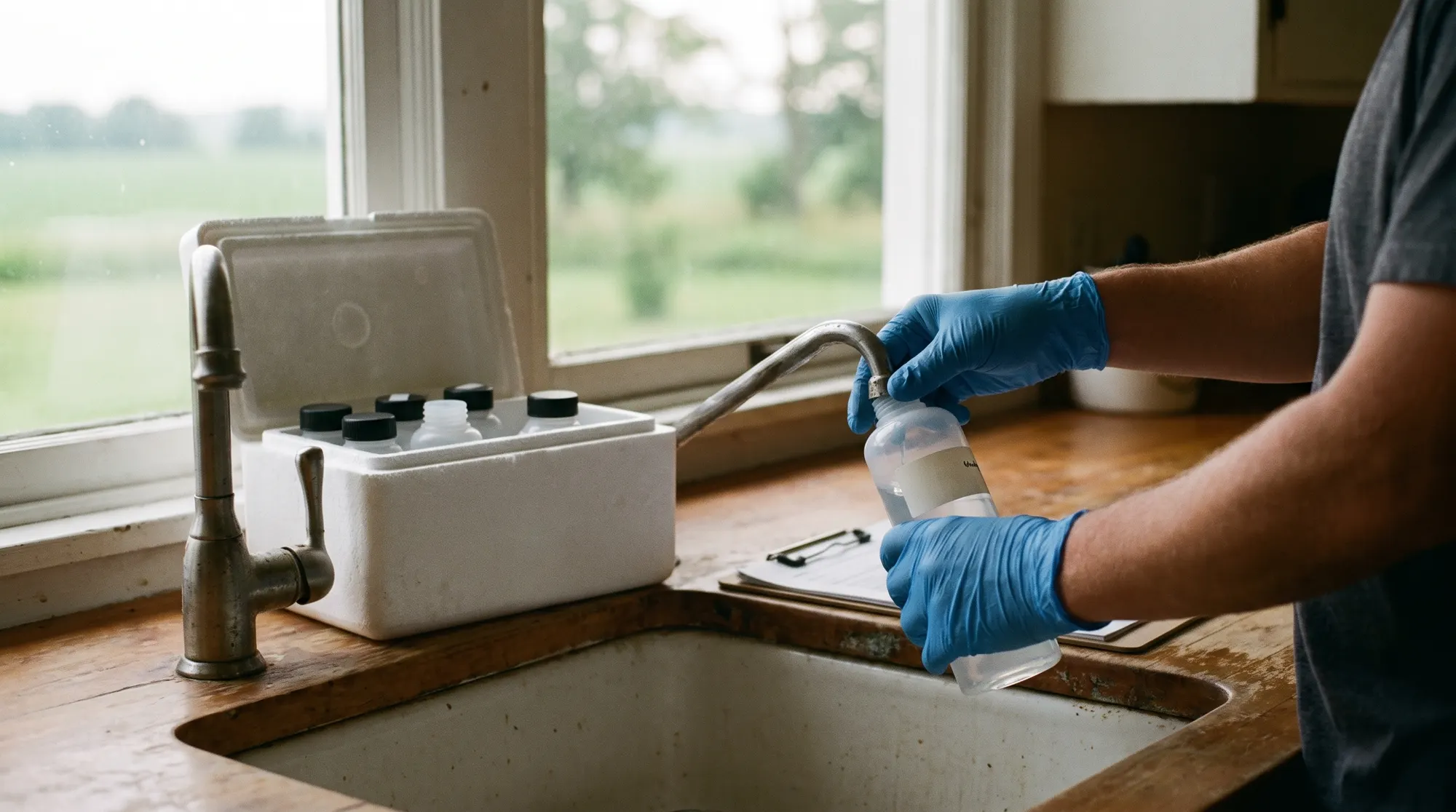
The key thing to know is that a standard private-well panel does not typically include PFAS, and usually not VOCs or arsenic either. Nitrate is on the annual panel; the others have to be asked for by name, from a laboratory equipped for them, with the collection instructions followed exactly. A clean report is genuine information about what it measured and no evidence about a contaminant it never looked for. Chatfield’s standard water test covers the annual panel; the specialized analyses are separate lab tests with a cost attached, requested when the prompts below apply.
Each has an EPA health limit, each comes from somewhere in particular, and two of them are missing from the test most well owners have already had. The lines are the EPA’s standards for public water systems; a private well has no rule, only the test.
| Contaminant | Where it comes from here | The line | On a standard panel? | The treatment |
|---|---|---|---|---|
| PFAS | Firefighting-foam sites (airports, military bases, fire-training grounds), industrial discharge, landfills, land where sludge was spread | 4 ppt PFOA · 4 ppt PFOS | No. A separate, specialized test | Activated carbon, ion exchange, or reverse osmosis at the tap, chosen from the result |
| VOCs | Fuel and solvent spills, gas stations, dry cleaners, industrial sites; the compounds move with groundwater | Set per compound | Usually not; ask for a VOC scan | Activated carbon at the point of entry, sized to the compound and the level |
| Nitrate | Fertilizer, septic systems, livestock; highest where the well is shallow and the land is farmed | 10 mg/L as nitrogen | Yes, on the annual panel | Reverse osmosis or ion exchange at the kitchen tap, and finding the source |
| Arsenic | Naturally present in some Pennsylvania bedrock; no taste, no color | 10 µg/L | Sometimes; ask for it | Reverse osmosis at the tap or an arsenic-rated whole-house system, then an annual retest |
| Lead | Older plumbing, solder, and brass rather than the well; acidic water pulls more of it | 15 µg/L action level | Ask for it, first-draw sample | Correct the pH, replace the source, reverse osmosis at the tap meanwhile |
WHY YOUR LAST TEST MISSED IT
Deciding Whether
to Test for PFAS.
Whether PFAS warrant testing on your property depends on local conditions and history rather than on general worry. Take these four steps in order, and avoid two mistakes: assuming a routine test already covered it, and assuming existing equipment is handling it.
- 01
Check the prompts
Look for known contamination in your area, a local advisory, or nearby sites where firefighting foam has been used (airports, military installations, fire-training grounds), industrial sites, landfills, or land where sludge was applied. Persistent household concern is a legitimate reason too.
- 02
Ask for it by name
A standard well panel covers bacteria, nitrate, pH, hardness, iron, and manganese. PFAS analysis is a separate, specialized test that has to be requested deliberately, from a laboratory equipped for it. Sampling has particular requirements; a compromised sample wastes the effort.
- 03
Read a clean report for what it measured
It is genuine information about what it looked for and no evidence about what it never looked for. Do not assume a routine test already covered PFAS, and do not assume existing equipment is handling it: a softener, a sediment filter, an iron system, and chlorine disinfection do nothing for it.
- 04
If a result comes back
Ask the laboratory or a qualified professional what the numbers mean and what confirmation is appropriate. Ask the health authority about interim precautions. Then discuss treatment against the confirmed results rather than the initial reading.
Chatfield’s process for any treatment question runs in the same order: test the water, assess the installation area, review the results and provide a clear quote, then install and verify. For a contaminant this specific, that sequence matters even more.
HEALTH CONTEXT, HANDLED CAREFULLY
What the Research Says,
and What It Doesn’t.
Prolonged exposure to certain PFAS, particularly PFOA and PFOS, has been associated in research with adverse health effects, including developmental and reproductive problems, liver and kidney damage, immune system effects, and increased risk of certain cancers. In 2024 the EPA set enforceable limits for public water systems, 4 parts per trillion each for PFOA and PFOS, and regulatory activity continues across federal, state, and local authorities. What none of that establishes is what any individual household should conclude. That depends on your actual results and your circumstances, and health questions belong with a medical professional and the appropriate health authority rather than a water treatment page.
- Nitrate. The 10 mg/L limit exists for infants under six months, whose blood cannot carry oxygen properly when nitrate is high. Boiling concentrates it. Don’t use tap water for formula until a result is under the line.
- Arsenic. A long-term exposure concern with a 10 µg/L limit, naturally present in some bedrock, and found only by a test that asks for it. An annual retest confirms a treatment system is holding.
- Lead. Most serious for children. It comes from solder, brass, and old service lines rather than the aquifer, and acidic water pulls more of it; a first-draw sample from a tap that has stood overnight is the only reliable measure.
- VOCs. Solvents and fuel components (benzene, trichloroethylene, and their relatives), each with its own limit, arriving from a spill or a site sometimes miles away. A VOC scan is a separate lab test; activated carbon is the usual treatment.
THE FIX
Built from the Result,
Not from the Worry.
Conventional treatment does not remove PFAS. Chlorine disinfection, standard filtration, a softener, a sediment filter, and an iron system all leave it in the water. Activated carbon adsorption and ion exchange reduce it; reverse osmosis at the tap protects the drinking water. Every such system is designed around confirmed results.
- A CUSTOM SYSTEM
PFAS, VOCs, and arsenic, whole-home.
Chatfield’s custom water treatment work addresses PFAS alongside VOCs, arsenic, chlorine, and bacteria: carbon, ion exchange, or an arsenic-rated media at the point of entry, chosen for the compound and the level the lab reported, and verified with a retest.
Every system we install - REVERSE OSMOSIS AT THE SINK
The drinking water, first and surest.
A reverse osmosis unit under the kitchen sink treats the water you drink and cook with: nitrate, arsenic, lead, and PFAS, at the one tap where it matters most. It is often the first system installed, and sometimes the only one a result calls for.
How reverse osmosis works
A LITTLE CLARITY
Contaminant Questions.
Straight Answers.
What are PFAS, and where do they come from?
PFAS, per- and polyfluoroalkyl substances, are a group of human-made chemicals used in industrial and consumer products since the 1940s for their resistance to heat, water, and oil: non-stick cookware, waterproof clothing, firefighting foams. That durability is the problem; they do not break down readily, which is where “forever chemicals” comes from. They reach water through industrial discharges, wastewater treatment plant effluents, and the use of firefighting foams, and they migrate over time from products containing them.
Does a standard well test check for PFAS?
Typically not. Common well panels focus on coliform bacteria, nitrate, pH, hardness, iron, and manganese, which are the right things to test for in most circumstances. PFAS analysis is a separate, specialized test that has to be requested deliberately. Public water systems are required to monitor and report PFAS under the Safe Drinking Water Act; private wells carry no equivalent requirement, so testing is the well owner’s decision.
Will my water softener or iron filter remove PFAS?
No. Chlorine disinfection and standard filtration are generally not effective against PFAS, and neither is a softener, a sediment filter, or an iron system; those address entirely different problems. Advanced approaches such as activated carbon adsorption and ion exchange may be used to reduce PFAS levels, and reverse osmosis at the tap is used for drinking water. Chatfield addresses PFAS through its custom water treatment work, designed around confirmed results rather than a general concern.
Should I test my well for PFAS?
Testing is a deliberate choice with a cost attached, and not every household needs to make it. Reasonable prompts include known contamination in your area, proximity to industrial sites, airports or military installations where firefighting foams have been used, landfills, or land where sludge was applied, or a local advisory. If you decide to test, ask specifically for PFAS analysis, confirm the laboratory is equipped for it, and follow the collection instructions precisely.
What are the EPA limits for PFAS in drinking water?
In 2024 the EPA set enforceable maximum contaminant levels for public water systems of 4 parts per trillion each for PFOA and PFOS, the two most studied compounds, replacing the earlier health advisories. Regulatory activity continues at the federal and state level. Those limits apply to utilities; a private well has no standard, which is why a result is read against them as a reference and discussed with a qualified professional and the appropriate health authority rather than treated as a verdict.
What about nitrate, arsenic, and lead?
Nitrate, from fertilizer, septic systems, and livestock, has an EPA limit of 10 mg/L as nitrogen, is on the standard annual panel, and matters most for infants under six months; boiling concentrates it. Arsenic occurs naturally in some Pennsylvania bedrock, has a 10 µg/L limit, and is found only by asking for it. Lead comes from older plumbing rather than the well, is worse on acidic water, and has a 15 µg/L action level on a first-draw sample. All three are treated at the kitchen tap with reverse osmosis, arsenic and nitrate also by whole-house or ion-exchange systems, and lead by correcting the pH and replacing the source.
Talk with the Chatfield team.
(724) 588-2652A LITTLE KNOWLEDGE GOES A LONG WAY
Know Your Water.
 WATER TESTING
Water testing, explained.
What a standard panel measures, what has to be asked for, and what the results mean.
 WATER PROBLEMS
Bacteria in your water?
The other health-based result on the annual panel, and what to do the day it comes back positive.
 WATER TREATMENT
Every system we install.
The named line, and the custom systems built for VOCs, PFAS, and arsenic from a confirmed result.

YOUR NEXT STEP
Ask for the Test
by Name.
A standard test covers the annual panel, and the specialized analyses are added when the prompts apply. Either way, the treatment is designed around what the lab actually measured.